
Skull & Books VR
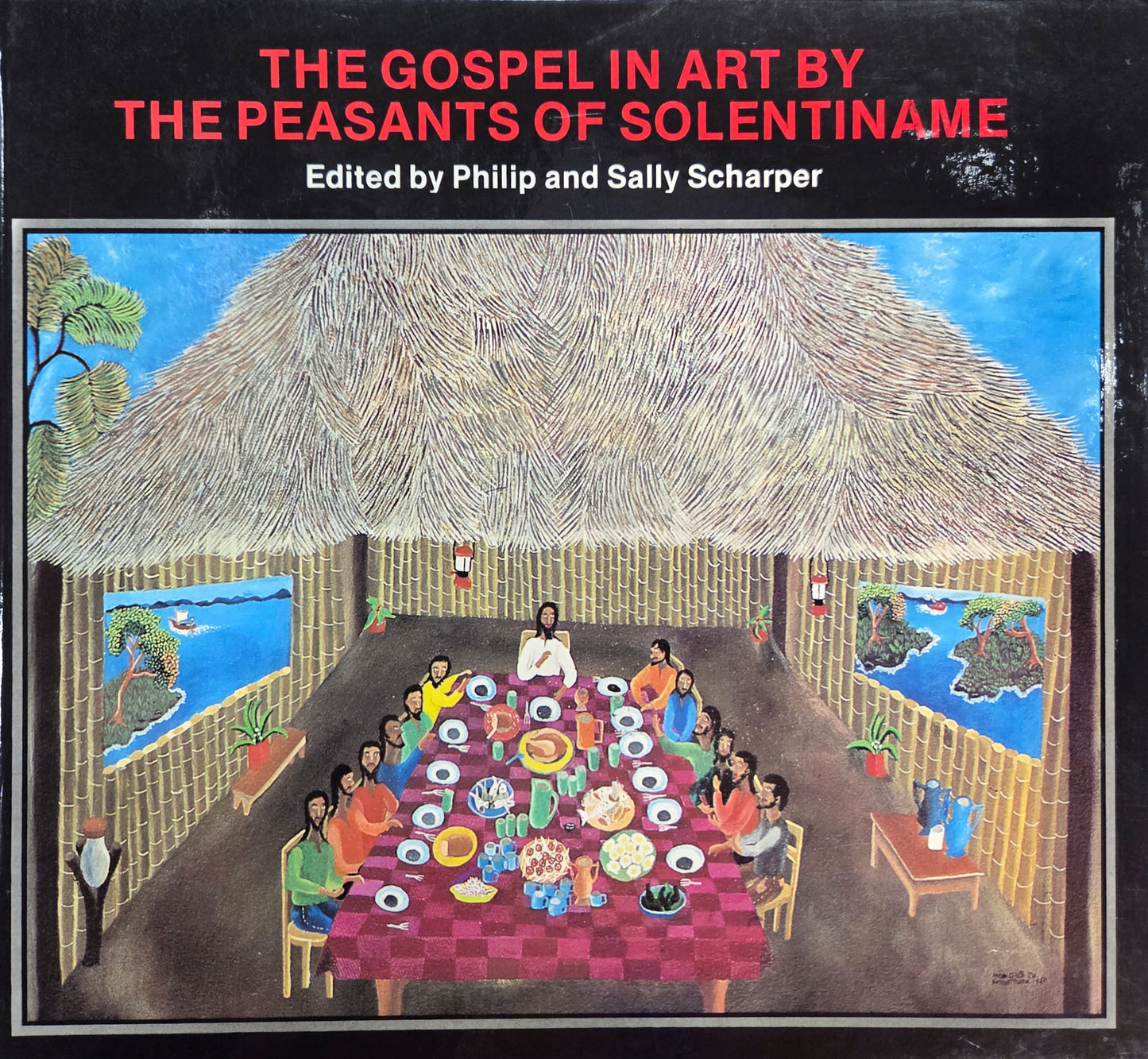
The Gospel in Art by the Peasants of Solentiname
The Gospel in Art by the Peasants of Solentiname
Couldn't load pickup availability
Solentiname is both a geographical location and a crossroads of the Spirit. An archipelago of thirty-eight islands in Lake Nicaragua, it had a population of some ninety families, farmers, craftspeople, and fisherfolk.
Here in 1966 a Nicaraguan priest, Ernesto Cardenal, with a Colombian poet, William Agudelo, and his wife, Teresita, began a small Christian commune. They cleared the land and rebuilt the small wooden church which had been started, then abandoned, twenty years before.
To that church the peasants now came in growing numbers for the Sunday Mass. But instead of a homily on the Gospel reading, there was a dialogue about it. "The commentaries of the campesinos," wrote Cardenal, "were usually of greater profundity than those of many theologians, but of a simplicity like that of the Gospel itself. This is not surprising the Gospel, or "Good News (to the poor) was written for them and by people like them."
"It was the Gospel," continued Cardenal, "which radicalized us politically. The peasants began to understand the core of the Gospel message: the announcement of the kingdom of God, that is, the establishment on this earth of a just society, without exploiters or exploited...."
Nicaragua at that time was far from being a "just society"; it was the fiefdom of the Somoza family, which the United States had sustained in repressive power for over fifty years. But Managua, the capital of Nicaragua and the corrupt center of Somoza's iron rule, seemed far away from Solentiname as the peasants developed a fish and farming cooperative, a clinic, and an artists' center.
The names "Cardenal" and "Solentiname" gradually became known through much of the world. Cardenal's poetry and spiritual writings were published in the United States and Europe. The work of the peasants - paintings, wood carvings, and metal work - were on sale in Switzerland, Germany, and France as well as in North and South America. A library was established together with a museum of the pre-Columban art found in Solentiname. The tape-recorded comments of the peasants on the Sunday Gospel were published, in four volumes, first in Spanish, then in German and English.
Both Cardenal's writings and The Gospel in Solentiname made clear to much of the world the utter depravity of Somoza's regime. So what Cardenal once described as "that near-paradise that was Solentiname" was doomed. In October 1977, Somoza's National Guard swept across the island, killing, raping, burning, and pillaging. Most of the peasants' huts were destroyed, the library was vandalized, boats and barns torched, the church turned into a military barracks.
The Gospel-rooted radicalism of the peasants turned now to revolutionary action. They threw their full support behind the Sandinistas, a people's army dedicated to the overthrow of Somoza. Overthrown he was, on July 19, 1979. The surviving peasants returned to rebuild Solentiname, its church, its farms, its art center.
But Ernesto Cardenal did not return. The new government appointed him Minister of Culture, a post which Cardenal regards as "priestly" because it deals with total human development through poetry, music, art, film, and sports. "If the revolution had wanted to take a different direction," observed Cardenal, "it should have placed all this in the hands of a militant atheist."
Share